Sustainability in sight? My trip to MedTech Expo
Part 3 of 3: What are the prospects for developing medical devices that support sustainability?
In his book Less, a thesis on how we could all be better off with fewer things, celebrity tailor Patrick Grant notes “the largest [NHS] trusts use between 4000 and 7000 single-use plastic gowns per day, and there are 215 trusts. Even assuming an average daily consumption of 1000 per trust, that’s well over 70 million disposable gowns a year”. There is a growing awareness that the healthcare sector needs to make sustainable changes, but how can this be balanced with the greatest leap forward in medical care – the knowledge that infection can be eliminated by maintaining sterile environments? This perfectly laudable drive for safety has meant that single-use items are now standard everywhere in medical care, from surgical instruments to face masks. It seems that the time has come to ask where it might be safe to try alternatives that can be used time and again, cutting down on waste that is often destined not for landfill, like household waste, but the incinerator.
View from the trade fair floor
At MedTech Expo, the first exhibitor I spoke to was a manufacturer of disposable surgical devices. She was keen to emphasise that much of the equipment used in surgery comes into contact with bodily fluids, such as blood tubing, and that this would present a biological hazard if reused. This company’s perspective, quite naturally in view of their product line, was that they would always need to be single-use. However, many other attendees and presenters were less sceptical.
One of these was an NHS doctor and researcher who presented a case study on the use of urine collection bags, which are a crucial part of the management of so many patients in acute care. These bags are enormously wasteful as they are made from single-use medical-grade plastic and they are incinerated at end-of-life. The presenter explained how he and his team had developed a reusable device that also substitutes a visual reading of volume for a weight measurement. This is perfectly logical, and follows the protocol for babies in ICU, where urine output is measured by weighing the baby’s nappy (the weight of the nappy before use being known). The device is a stand with in-built weighing technology, automated to provide non-contact readings of the urine bag hanging on the hook at regular pre-programmed intervals. The bag itself can be sterilised and re-used, and is currently being trialled and is on version 4. He reflected on the difficulty of pinning down the NHS carbon footprint, with no standardised assessments, but given that acute care is undoubtedly the greatest contributor any innovation that replaces a single-use device with one that can be sterilised and re-used must be seriously considered. Returning briefly to Patrick Grant, he points out that single-use gowns were not always the standard, but that many hospitals closed down their industrial laundries as the cheaper and simpler option became widespread. Happily, it appears that large NHS trusts all have their own sterilisation and decontamination units, and these may be called on to expand as the safety and acceptability of reusable devices grows.
Panel on sustainability
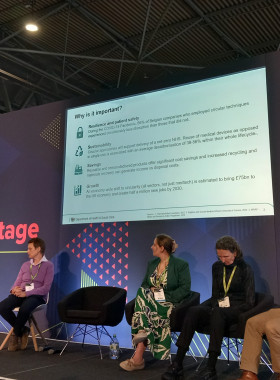
On the second day, a panel discussion looked at how sustainability should be taken into account in the development stage of a new medical device, as well as when bringing it to market. “If sustainability isn’t part of your innovation, you’re missing a trick” was the message from product designer Rich Shaw. He indicated that today’s funders want to see that the environmental impact of a product is a genuine consideration and that developers are embracing the goal of reducing the carbon footprint of the health service. After all, a product will ultimately need to be sold to healthcare providers at scale in order to succeed. In the UK, the NHS is committed to an 80% reduction in indirect carbon emissions, under which banner it includes medical devices, by 2036–2039 and net zero by 2045. This means that healthcare trusts are required to consider sustainability in all its facets when making purchasing decisions, and consequently addressing sustainability is a unavoidable for product developers. The panel made it clear that it is not simply a case of using recyclable packaging and calling it green. The whole lifecycle of a product needs to be looked at, and a sustainability lens used at every stage. This means conducting serious assessments to review whether using a given material really is better for the environment, taking in consideration its production and use through to how it is disposed of at end-of-life.
The panel gave some examples of pilot projects where a transition from disposable to reusable products had been trialled, including the tray wraps that protect sterile surgical instruments during transport. Substituting disposable wraps with sturdier containers was piloted in Cardiff and they were found to offer significant cost and emissions savings. In addition to this, staff preferred the re-usable containers because they were more robust and offered better protection during transport. Similarly, a trial of reusable bronchoscopes in Cambridge not only offered cost savings of over £20,000 in year 1 and an estimated 200 kg reduction in carbon emissions, but the reusable scopes were rated as producing better image quality, accuracy and patient comfort. These projects and more are explored in much more detail in this policy report published by the Centre for Sustainable Healthcare Networks.
The Q&A session led to an interesting counterpoint to the opinion I heard initially on day one. The question was raised whether single-use blood contact products, like tubing, could ever be reusable in view of the risk of prion contamination. The response was a guarded “never say never”, if sterilisation technology improves.
Change on the horizon?
- Disposable medical devices substantially contribute to the 156,000 tonnes of clinical waste that the NHS produces every year in England alone. (Source: (link: https://www.gov.uk/government/news/major-crackdown-on-nhs-waste text: UK Government))
- While single-use items are everywhere in healthcare systems, not everything has to be disposable.
- Healthcare trusts are looking at how to cut plastic waste and which items could be reusable, where sterilisation is practical and effective.
- New products in development must factor in sustainability at every stage of the product lifecycle to attract potential funding partners.
- These changes are inevitable in view of health service commitments to reduction of direct and indirect carbon emissions.
From a professional perspective, it was extremely useful to gain an insight into how the sustainability debate is being framed in the medical device industry, and to hear the opposing views. I now know that there are medical professionals and developers who are passionate about driving this change, which is being rolled out in multiple small ways through numerous different projects. This is essential if the NHS is to meet its net zero targets (for more information see Greener NHS). I have no doubt that healthcare systems around the world are setting similar goals, and translators may have a part to play in doing what we do best – helping to communicate best practice across linguistic borders.