Innovative and impactful: my trip to MedTech Expo
Part 2 of 3: Exploring advances in technology
I have no great history of being an early adopter. In 2004, my then-boyfriend now-husband showed me the new “i-Pod” he had bought and raved about the 400 songs he could now have in his pocket. Why would I want that, I wondered, I already have a caseful of CDs and a diskman.
My burgeoning interest in innovative medical technology would no doubt surprise my 20-something self (although I still have all those CDs in a box under my bed). Over my the past 15+ years I have researched absorbed information about numerous medical innovations while working on medical translation projects, and now was the time for me to get ahead of the game and find out what’s new in MedTech before it landed in my inbox.
Advances in materials
Orthopaedic implants
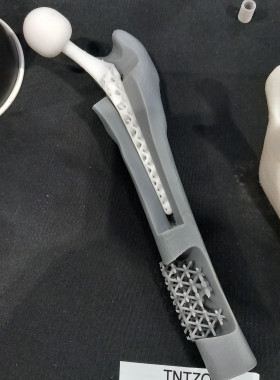
As an add-on to the MedTech Expo, there was a 3D-printing event that attendees could access. This meant there was some interesting overlap and, having heard about 3D printed custom hip and knee implants, I was delighted to be able to see these up close on the University of Birmingham’s stand. PhD student Peter Ibrahim was kind enough to talk me through his research, showing me the new flexible metal alloy (TNTZO) that they are developing, and I was able to pick up and study the protoype femur on show. Peter explained to me that the femoral stem would be custom printed from a patient's CT scan, and that the ball was not quite as tailored, but could be selected from a range of suitable pieces.
It offers the advantage of a femoral stem incorporating two lattice sections, which are there to encourage the patient's own bone to grow into the space. This should offer improved long term prospects for hip replacement patients, who are now living longer and with more active lifestyles, meaning the hardware implanted has to bear up to the strain!
The next step for the Birmingham team is testing in an animal model, and then hopefully they will ultimately be able to take their device to market. It was exciting for me to be able to see an innovation I had only read about so far, and interesting to hear more about the journey from idea to market.
An absorbable implant material
Another innovative material on display was a 3D printed bio-absorbable filament, which I was already aware of through its application in the Matisse breast implant. A French start-up called Lattice Services have developed a biologically compatible 3D-printable material that can be used to create implants for a range of surgical applications. As with the orthopaedic implant developed by the Birmingham team, it uses a lattice structure to encourages the patient's own soft tissue to grow and fill the space, but this one offers a hugely impactful benefit in that it is totally resorbable within 36 months.
Still at the experimental stage, this product is currently being tested in small scale clinical trials in France and Spain. It was a privilege to be able to speak to the company representatives and to hear more about where they are heading and their current challenges.
New approaches to testing
In my last post, I talked about some of the useful talks about regulation on offer. The presentations also showcased innovative products, including wearable tech such as the Kiffik device, and I was lucky enough to grab a few minutes with speaker and regional president Les Lindsey as he enjoyed a sandwich afterwards.
He explained to me that he wants to offer an alternative to blood tests by taking samples of interstitial fluid (the watery part of blood), which is rich in biomarkers but has historically been virtually impossible to sample. Many people find blood draws stressful and are even put off having them at all. A need for repeated blood tests could impact a patient’s decision on whether or not to enrol in a clinical trial. The Kiffik device can be sent out to a patient for them to use at home, and then return by post for results. It is non-invasive, attaching to the arm and performing a clever series of vibrations that extracts the interstitial fluid through temporary micro-openings.
This process is one pillar of its innovation – overcoming the challenge of extracting interstitial fluid. A second innovative aspect is that when the device is returned, the results can be analysed using AI. And this, to me, is the kind of application where AI truly does a job that humans cannot. It can analyse a massive data set and deliver information on numerous biomarkers, meaning it could have a potentially huge range of applications. It was such a pleasure to speak to Les about this, and I hope we’ll be seeing it find a place in patient care in future.
In a nutshell
- Witnessing innovations in person transforms abstract knowledge into vivid understanding. Seeing 3D-printed custom hip and knee implants up close brought home to me how theory meets real-world application.
- 3D printing offers opportunities for patient-specific implants, some of which can safely resorb over time. Filaments used in products like the Mattisse breast implant dissolve within 36 months, reducing long-term risks and surgical interventions.
- AI can do some things that humans can't, and would arguably be best focused on these applications. Combining AI's analytical potential with a non-invasive device leads to a patient-friendly path to richer diagnostic data.
In short, a trade fair is a great opportunity to see up close advances that you have so far only read about or fallen down a rabbit hole researching. In the spirit of trying new things, when I visited one Thai exhibitor and they offered me a choice of confectionary, I selected the durian flavoured crispy roll. In this instance, innovation offered rather a mixed bag!