How do specialist translators keep up their knowledge?
When you entrust your key documents to a specialist translator, you will want to be sure that they are familiar with your field to be confident of a successful outcome. But how is it possible for an independent professional, without the resources of a large company behind them, to find the time and budget to keep on top of the latest developments in your field? Let's have a look at how this aspect of continuous professional development can be implemented into a freelance translator's practice, from the personal perspective of a seasoned medical translator (that would be me!).
Although I've been working as a medical translator since 2008, in the first years of my career the majority of my knowledge was built up from intensive research. This meant reading trusted sources, consulting medical textbooks and reaching out to the health professionals in my network. This all involved significant effort and it achieved the goal of equipping me to provide accurate translations of medical documents such as patient reports, package leaflets and journal articles, but it was reactive rather than proactive.
While research on the job is a key part of every medical translation project, it's also important to be look ahead by delving into continuous professional development. Keeping up specialist knowledge is just one part of CPD, since source language skills, translation techniques and business skills can also be included. However, domain-specific understanding is a critical asset that specialist translators can offer their clients and ways to access it are a crucial consideration.
Online learning
There is a wealth of opportunity to attend courses and webinars online, which many independent specialist translators doubtless reach for as they are usually accessible both in terms of time and money. A few years ago, I wanted to improve my knowledge on internal medicine, so I followed a FutureLearn course on abdominal anatomy and pathology. I learned an immense amount from this self-paced course, and built up a useful glossary of key terms that I still refer to today, particularly concerning the liver and its diseases.
In the past two years, I have been attending webinars in my specialist area of orthopaedics run by French and European learned societies, such as SOFCOT (Société Française de Chirurgie Orthopédique et Traumatique). These are usually presented in French, and they offer me the chance to hear medical professionals discussing key anatomical or surgical concepts in my source language (the language I translate from). Those given in English are equally advantageous, because I can learn the latest terminology being used in my target language (the language I translate into).
In-person events
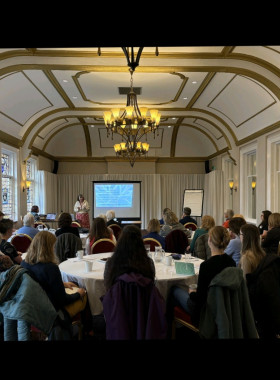
Of course, not all learning happens behind a screen. Face-to-face events bring a different kind of depth and over the years I have attended some outstanding workshops run by the ITI's medical and pharmaceutical network. I have been a member since 2009 and in March 2025 I took over the role of coordinator; I may be biased but I believe we offer the best CPD going for medical translators.
A typical ITI Medical Network workshop involves two lectures from a medical professional plus a practical session, working with colleagues on a related translation. This format offers access to really unique opportunities for attendees to deepen their understanding. Presenters are asked to pitch their talk as if addressing first or second year medical students. This means assuming intelligence and some background knowledge, but lacking a deep familiarity with the nuances of their specialism. I have attended talks from specialists across emergency medicine, oncology, surgery and palliative care. From every one of these, I took away surprising and useful insights, that enriched my translations. Events like this both consolidate domain-specific knowledge and help independent translators to expand their network and learn from others.
Many of the Institute of Translation and Interpreting's other subject networks run similar events, which give specialist translators unparalleled CPD opportunities. I read with envy about the ITI Beauty, Fashion and Luxury Network's recent outing for a fragrance workshop with a perfumery professional, to allow them to really experience their specialism up close with multiple senses. They had the chance to make notes on different scents, learn about the various components that go into a perfume and even create their own fragrance to take home. Coordinator Vicky Porter-Burns commented that it was "a wonderful opportunity to expand our knowledge of perfumery...aside from everything we learnt and the masses of knowledge shared with us over the course of the afternoon, the whole workshop was a hoot from start to finish!".
Peer learning
Another really accessible way for freelance specialist translators to learn is to form a revision club with colleagues working in the same language pair and field. Although this is generally a group of translators rather than, in my case, practising health professionals, we all have differing experience and can share insights that we have come across in our recent research.
Trade fairs and conferences
I have attended both of these types of event this year, and you can read all about what I learnt from MedTech Expo in previous articles. A trade fair is a completely different experience to more formal learning because you never know what you are going to find out about, but you can be sure it will be something new and cutting edge. Some specialist translators may also choose to attend conferences aimed at professionals in their specialist field. While a conference aimed at doctors is out of reach for me, I did have the chance to attend MedTranslate in October 2025. At this conference for the medical translation industry I was able to see and even try out ultrasound imaging systems – there is no substitute for seeing and exploring equipment that you have previously only read and written about. It brought my understanding to a whole new level.
Staying sharp in a specialist field
-
Formal CPD is essential to move from reactive research to proactive expertise.
-
Online courses and webinars provide accessible, affordable ways to build domain-specific knowledge.
-
In-person workshops, peer learning, and conferences deepen understanding and expand networks.
-
Investing time and resources in specialist knowledge strengthens client trust and demonstrates commitment
For all these types of CPD, one of the advantages of being an independent specialist translator and not working for a large company is that you have the freedom to choose what you want and need to learn, and you can give yourself the time off paid work to attend. This could mean that some freelancers end up doing more in-depth learning about their specialist field than counterparts in in-house teams. Naturally, budgets are not endless in a small business, but any good independent professional will see deepening their specialist knowledge as an investment rather than an expense.